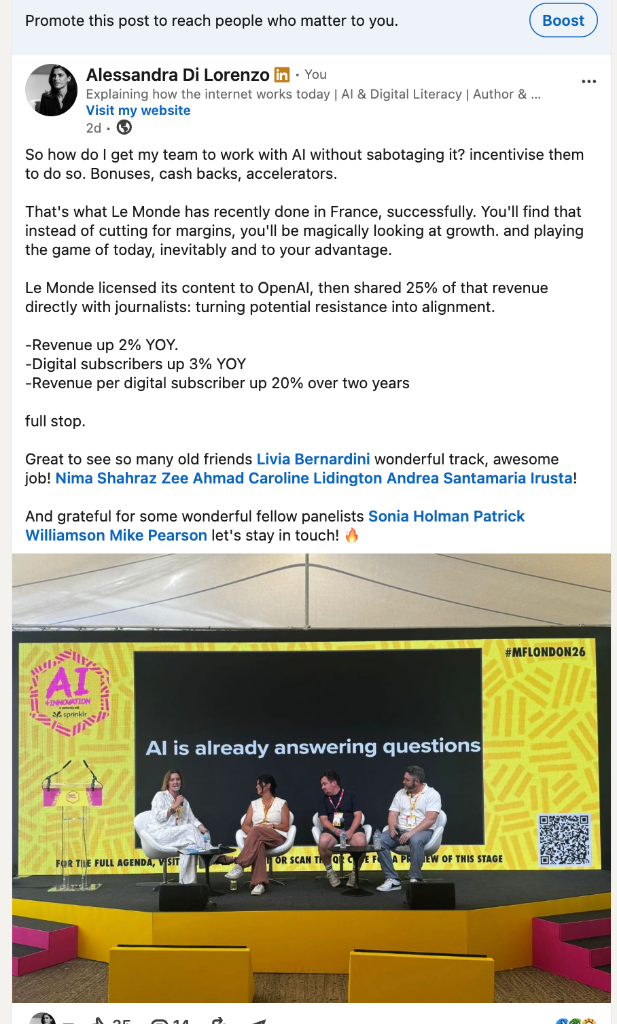
Incentivise Your Team to Work with AI
The fastest way to get your team to adopt AI is to make it worth their while. Le Monde did exactly that — and the numbers speak for themselves.

The fastest way to get your team to adopt AI is to make it worth their while. Le Monde did exactly that — and the numbers speak for themselves.

We blame "the algorithm" for everything. Almost none of us can explain it. Here's what it actually is—and why it matters.

Children are growing up inside systems that predict, rank, recommend, generate, measure and learn. Here's what that actually means.

A harmful post is content. A harmful loop is system design. And parents are consistently given advice for the wrong problem.
Photo: Jon Tyson / UnsplashWhy platforms are no longer selling products—they're selling your attention, and the bill is getting higher.

Six questions that actually work. Because banning technology is not a strategy, and curiosity works better than confiscation.

Children who spend more than 3 hours a day on social media face double the risk of poor mental health outcomes. The internet knows this. And it doesn't care.
Photo: Cash Macanaya / UnsplashWe're moving from platform driven feeds to AI determined search. What changes?

You mention trainers in conversation and ads appear seconds later. Coincidence? Here's what's actually going on.

Why the content your child sees matters less than the system deciding what they keep seeing—and what parents can actually do about it.
Photo: Immo Wegmann / UnsplashAnd that's not necessarily a bad thing—if you understand how.


From trending topics to predictive algorithms, the internet seems to know what's coming. But does it really?

The grey browser icon feels reassuring. The reality is considerably less so.
Photo: Liana S / UnsplashHow digital systems turned influence into a science, and what it means for your freedom of choice.

The most dangerous products on the internet don't cost a penny. That's not a coincidence.
Photo: ObjectType Raw / UnsplashAI is eliminating the need for users to click. Here's why that matters.

Most people assume the internet is a shared experience. It isn't—and the gap between what we each see is wider than you think.
Photo: Alexander Lunyov / UnsplashUnderstanding the illusion of personalization in digital systems.
Practical thinking for parents navigating AI, algorithms, and children's digital lives.
Photo: Artur Aldyrkhanov / UnsplashWhy the content your child sees matters less than the system deciding what they keep seeing—and what parents can actually do about it.
Photo: Caleb Woods / UnsplashChildren who spend more than 3 hours a day on social media face double the risk of poor mental health outcomes. The internet knows this. And it doesn't care.
Photo: Katsiaryna Endruszkiewicz / UnsplashSix questions that actually work. Because banning technology is not a strategy, and curiosity works better than confiscation.
The internet is full of half truths. These articles separate the signal from the noise.
Photo: Microsoft Copilot / UnsplashYou mention trainers in conversation and ads appear seconds later. Coincidence? Here's what's actually going on.
Photo: Petr Sidorov / UnsplashFrom trending topics to predictive algorithms, the internet seems to know what's coming. But does it really?
Photo: Microsoft Copilot / UnsplashThe grey browser icon feels reassuring. The reality is considerably less so.
Photo: Microsoft Copilot / UnsplashThe most dangerous products on the internet don't cost a penny. That's not a coincidence.
Photo: Markus Spiske / UnsplashMost people assume the internet is a shared experience. It isn't—and the gap between what we each see is wider than you think.
A clear, intelligent guide to how digital systems really work — algorithms, advertising, AI, and the invisible forces shaping what you see, think, and buy. No hype. No jargon. Just clarity.
No spam, ever. Unsubscribe anytime.
Di Lorenzo lifts the curtain on digital persuasion with wit, candour and practical hacks. I finished feeling smarter, not scared.
Amazon Review